
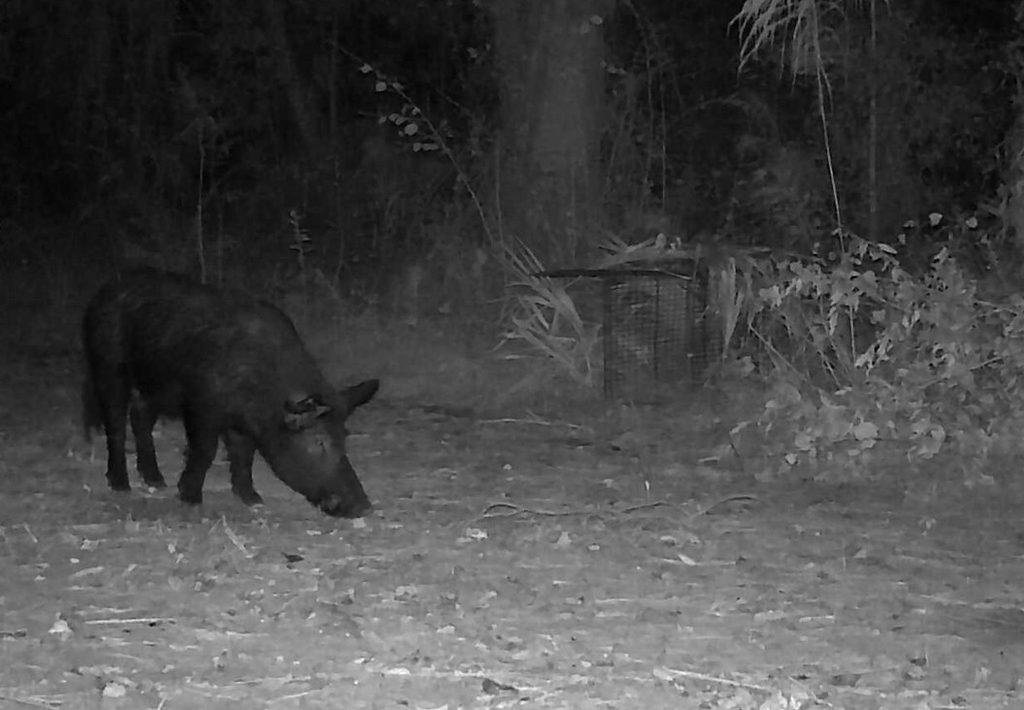
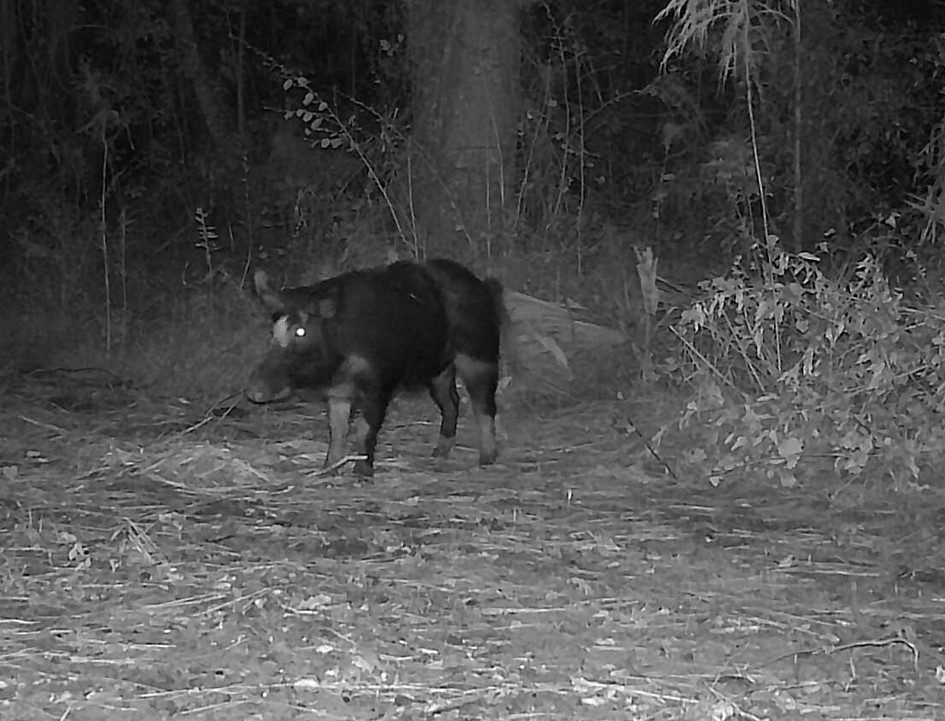
Understanding the signs and patterns of feral hog activity is essential for choosing the right location and timing. Hogs typically leave clear indicators that reveal patterns of movement and behavior. We leverage technology in our approach, we use cameras to better understand what we need to know to be successful.
The process
Identify signs of hog activity
Gather intelligence – Inspect travel patterns and environments, food and water sources
Monitor the area with cameras for visitation routines
Erect the trap in high-potential locations using the gathered data
Condition the hogs to trust the trap and the food source for a few days, then arm the trap
Adjust based on seasons and behaviors
The signs we look for
“Rooting” – Disturbed soil from feeding activity, often covering large areas.
“Tracks & Trails” – Repeated paths showing consistent travel routes.
“Wallowing” – Muddy depressions used for cooling and parasite control.
“Rubbing” – Trees marked with mud and hair after wallowing.
Multiple signs in one area often indicate repeat activity, making it a prime candidate for trapping.
The trapping technology
Cellular cameras offer us a deep insight into what animals are visiting and what times they frequent, sometimes it also helps us to know what they prefer to eat. We can capture still images or videos and also capture sounds, depending on the specific need. We also have cameras that can monitor a target area “live on demand” and see what specific behaviors we may need to adapt for and plan accordingly. This comes in very handy when we have target hogs competing for the same food source, understand who is the dominant boar or sow and sometimes make special exceptions to adapt to the surroundings. The ability to capture audio can be an advantage we utilize. Hogs are very vocal animals and a dominant hog may send warning vocalizations to other pigs if they find themselves uncomfortable in certain situations. We will use every advantage we can, to help you catch hogs.
Trap technology has evolved a lot over the past 10 years. You may have heard of hogs becoming “trap shy”, this happens when a hog has been previously exposed to metallic box traps and either witnessed another hog getting caught in a trap and sending distress vocalizations, or experienced this themselves and somehow was able to escape from the trap. Older hogs are much more leery around traps than young adults or piglets. Net style traps represent the latest evolution of trapping technology. During the conditioning phase of the catch, a portion of the net is allowed to hang down, allowing the net to touch their faces and backs when they enter the trap. This is similar to hogs walking through the thick palmetto bushes and brush, it is a familiar feeling for them. The second advantage to a net style trap is the fact that they are a continuous catch system, meaning the hogs crawl and root under the net until they get to the bait. I have personally seen 23 hogs in one trap. Several large adults, mixed with juveniles and piglets. The double netting is comprised of small squares, much like a batting cage style net, so the smaller pigs are unable to escape. Typical large box traps lack the ability to hold the smaller pigs unless the builder of the box encorporated the proper style mesh to keep them in the catching system.
Deploy the right product
For single hogs or small trapping areas, we typically deploy a 20″ x 48″ or 4′ x 8′ box trap with a step plate trigger, similar to the common possum, armadillo and raccoon traps.
For groups of hogs and larger open areas, we typically deploy the net trap
For specialized situations, we deploy a corral trap with an electronically controlled remote latch, can be sized to suit the working area and size of target group.
A large box trap can hold up to 4 or 5 pigs, but because the door is triggered by a manual step plate, we cannot control how many hogs we trap. Average success rate is 1 large hog, or a female with a couple piglets or young adults.
A net style trap is a continuous catch system. Once the hogs are conditioned to the trap and relying on the bait as a daily source of food, the amount of hogs trapped can vary.
Large corral traps are for special situations and would require a consult with the client to discuss the amount of time and effort to trap a large group of hogs and rental pricing.
Having the right trap and deploying it in the right place—is very important.
Interesting hog facts
1. They can run up to 30 MPH.
Feral hogs are surprisingly fast, muscular animals.
2. They can breed year-round.
A sow can potentially produce 2-3 litters per year, with 4–12 piglets per litter.
3. They can start reproducing at just 6–8 months old.
That means a piglet born this year could potentially be contributing to the population before you know it.
4. A group of hogs is called a “sounder.”
Sounders are typically made up of multiple adult sows and their young. Groups can range from just a few animals to 30 or more.
5. The hogs you see aren’t necessarily all the hogs that are there.
Adult boars commonly live alone or in bachelor groups, while sows and young tend to travel together in sounders.
6. They’re often active when you’re not.
Feral hogs are frequently active at night, particularly in hot, humid climates. That’s one reason you may rarely see the animals responsible for the damage you find in the morning.
7. They can root surprisingly deep.
USDA documents feral swine rooting ranging from shallow disturbances to approximately 3 feet deep in some circumstances.
8. They don’t just eat plants.
Feral hogs are opportunistic omnivores. They consume crops, roots, acorns and other plant material, but can also eat insects, reptiles, amphibians and other animals. USDA has documented feral swine killing and eating deer fawns as well.
9. Your lawn can be a buffet.
Hogs root through soil looking for food such as roots, grubs and other invertebrates. That means they don’t need a crop field to cause serious damage—lawns, pastures and landscaped areas can become feeding grounds too.
10. They can damage more than what’s on the surface.
Rooting can damage pasture, crops, landscaping and soil, while hogs can also break irrigation lines and damage fencing and other structures.
11. Hogs don’t sweat like we do.
Feral swine use mud wallows to help cool themselves and protect their skin from insects.
12. Hogs can affect water quality.
Rooting, wallowing and concentrated fecal material can contribute to erosion and contamination of water sources.
13. They’re an invasive species in the United States.
Feral swine are not native to the Americas. Domestic pigs were introduced centuries ago, and later introductions of Eurasian wild boar contributed to today’s feral swine populations.
14. They’re incredibly adaptable.
Feral swine can survive in a wide variety of habitats, which is one reason they’ve been so difficult to manage across their introduced range.
Got a small problem animal? We also offer small & medium size trap rentals!
We also offer small & ,edium box traps with a step plate trigger, for catching possum, armadillo, raccoons and other nuisance animals. Our medium traps are steel ring reinforced, if you catch something bigger than expected, it won’t get away!
Credits: Some of the facts and images used on this website were obtained from information gathered from FWC and APHIS (USDA) and other feral hog study groups that supply data to several state agriculture groups.